
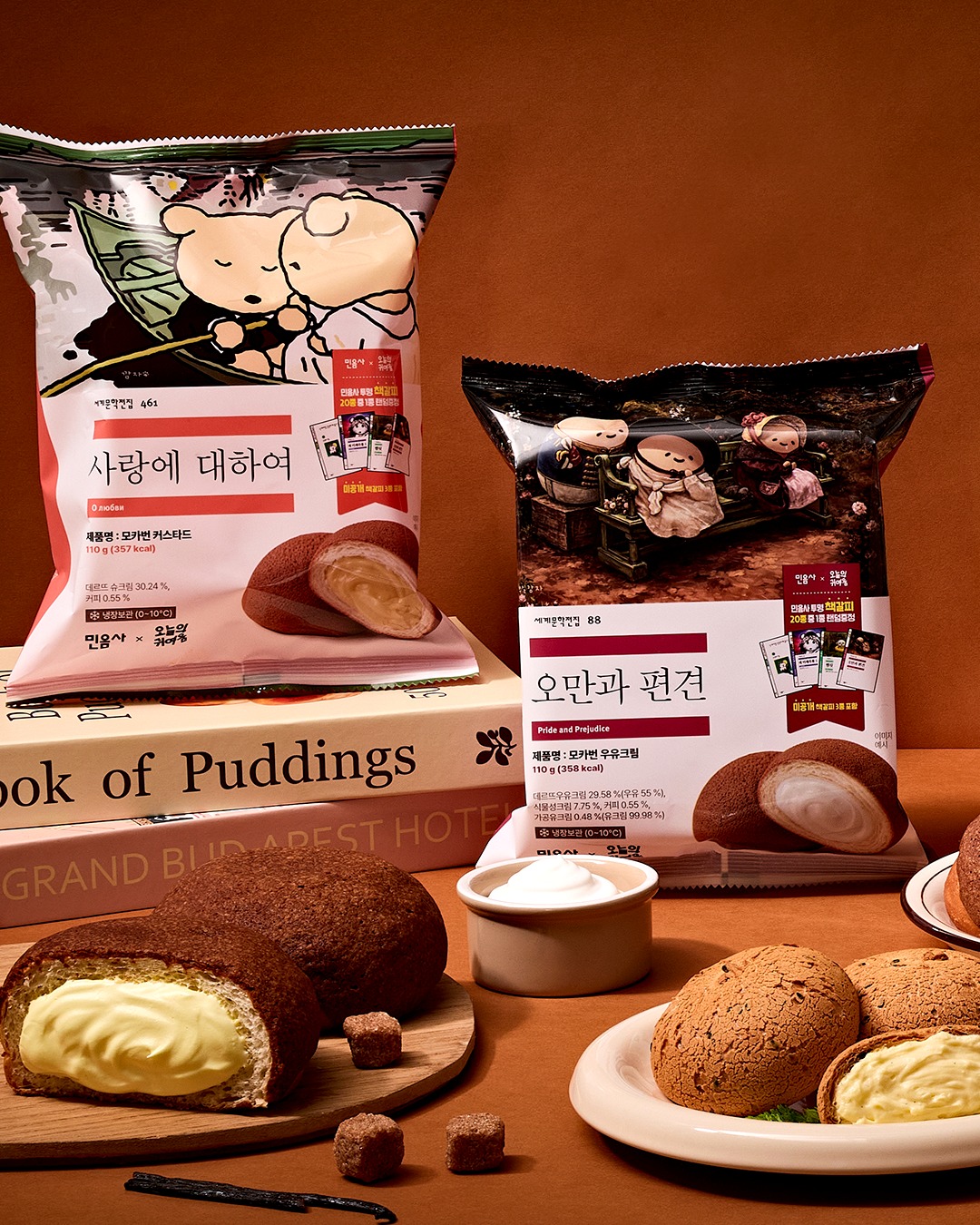
Image: GS25 official Instagram
Summary
- GS Retail said the first two GS25 x Minumsa literature breads sold more than 100,000 packs from August 21 through August 25, ranking first and second in the chain's bread category.
- The permanent line now has four products priced at KRW 2,700 or KRW 3,700, with one of 20 transparent literary bookmarks packed inside.
- Retailer-reported app DAU rose 10.9% around the launch, while temporary staffing and night production were added to meet demand.
- Launch
- August 21, 2026
- First-five-day sales
- 100,000+ packs
- Products
- Four permanent GS25 breads
- Prices
- KRW 2,700 / KRW 3,700
- Collectible
- 20 transparent bookmark designs
A bun launch with book-release energy
The most talked-about new literature release in South Korea this week may be sitting beside the sandwiches. GS25's collaboration with publisher Minumsa and character brand Today's Cute turns four literary titles into packaged breads, then slips a transparent bookmark inside each wrapper. According to GS Retail figures reported by Yonhap, the first two products sold more than 100,000 packs between August 21 and August 25 and took the top two places in GS25's bread sales ranking.
The first pair translated On Love into a mocha bun with custard and I Wanted to Howl Freshly Like a Wolf into a chewy glutinous-rice bread with salted-milk cream. On August 26, GS25 added a milk-cream mocha bun for Pride and Prejudice and a custard-filled glutinous bread for A Bad Boy Is Standing There. The mocha buns cost KRW 3,700 and the glutinous breads KRW 2,700, according to product information published on August 26.
This is more than a cover printed on a snack. The packaging borrows Minumsa's recognizable book design, while each bread contains one of 20 transparent bookmarks drawn from the publisher's World Literature and poetry catalogues. Three designs are exclusive to GS25. The result is a small collecting loop: eat the bread, reveal the bookmark, check the next store's stock, repeat.
Why the convenience store is the right stage
Convenience stores compress discovery and purchase into a few minutes. A customer does not need to plan a bookstore visit or commit to a full-price hardback to signal literary taste; a KRW 2,700 snack can do it at the register. GS25 reinforced that low-friction loop with inventory search in its Our Neighborhood GS app and a buy-one-get-one offer for GS Pay purchases through August 31.
The retail response was visible beyond unit sales. GS Retail data reported by Dnews showed average daily active users for the app at about 974,000 from August 21 to 24, up 10.9% from roughly 878,000 on the comparable weekdays a week earlier. The company added 30 temporary workers and a night shift, but still struggled to supply stores nationwide.
Those numbers are retailer-reported and cover the launch window, so they should not be mistaken for proof of lasting demand. The payment promotion, the reveal mechanic and early scarcity all helped create urgency. GS25 says the products are permanent rather than limited editions, which makes repeat sales after the promotion the more useful test.
Text-Hip turns reading into a visible identity
In Korea, “Text-Hip” describes the idea that reading, annotating and sharing books can function as a contemporary style signal. The phrase can sound superficial, but the audience trend underneath it is not invented. A Culture Ministry reading survey released in March 2026 found that the annual reading rate for people in their twenties rose 0.8 percentage points to 75.3%, even as the adult rate overall fell 4.5 points to 38.5%.
Literature bread fits that split neatly. It does not require the buyer to claim that purchasing a bun equals reading a book. Instead, it turns a literary reference into an affordable, photographable and collectible object. The bookmark is useful, but it is also social proof: Minumsa's catalogue can appear in a phone photo, on a desk or inside another book.
That distinction matters. A successful snack collaboration cannot show that more people finished Pride and Prejudice. What it does show is that publishing design, book titles and reading identity can move consumer behavior outside the bookstore. The collaboration made shoppers search inventory, change payment methods and revisit stores—actions that are unusually concrete for a cultural trend often discussed only through aesthetics.
A publisher's archive moves into the everyday aisle
Minumsa has something many consumer brands spend years trying to build: a deep archive whose covers and titles are already recognizable. GS25 did not flatten that archive into a generic “bookish” pattern. It used named works, series design and bookmarks, allowing each product to carry a fragment of a larger catalogue.
That is why the collaboration feels more durable than a logo swap. The bread provides reach, the bookmark provides a reason to collect, and the books provide meaning that can survive after the snack is gone. The next signal to watch is not another launch-week sales spike. It is whether interest persists after the promotion—and whether other publishers learn to treat their archives as living consumer worlds rather than static backlists.

Comments